It was mid-August when one of my young cricket-enthusiast friends in Kolkata, requested me to author an article on Sri Lankan cricket for their FaceBook group’s maiden Bengali e-magazine venture. That rang a bell in my mind. While I was writing that article, my family was pondering over a vacation in our neighbouring island nation during the Christmas week. I made sure that a couple of cricketing venues in Colombo and Galle were included in our itinerary. After my Lord’s visit in 2023, it had to be cricket grounds in Sri Lanka this time.
Sri Lanka has a long cricketing history – the Colombo Cricket Club was started in 1863. The MCC squad, on their way to Australia in 1882, played a two-day exhibition match there but that had to be called off early on the second day because their ship had to depart the port with the English players. That perhaps is the genesis of the term ‘whistlestop matches’!
Let us not forget that Colombo is the only city in the entire Indian Sub-continent where three of cricket’s all-time great batters – WG Grace (Oct-1891), Don Brandman (Apr-1930 and Mar-1948), Len Hutton (Oct-1950) – have played cricket, albeit in exhibition matches, en route their respective Ashes tours. That way, Colombo scores over all cricket-crazy venues in India, Pakistan, and Bangladesh although the last-named country was yet to be born then.
That is enough of history – let me now come back to December-2025!
Sri Lanka Cricket Museum, Colombo
This museum is located at Maitland Place, Colombo, Sri Lanka, at the former Asian Cricket Council (ACC) headquarters, adjacent to the headquarters of Sri Lanka Cricket (SLC). It was officially opened by the then Minister of Sports in Feb-2019 and is operated by the SLC. The idea was that it would honour and strengthen the game of cricket and its followers. Its role was to encourage and inspire the young people of the country to serve their nation with courage, honour, and humility – inspiring a nation of sports lovers being its motto.
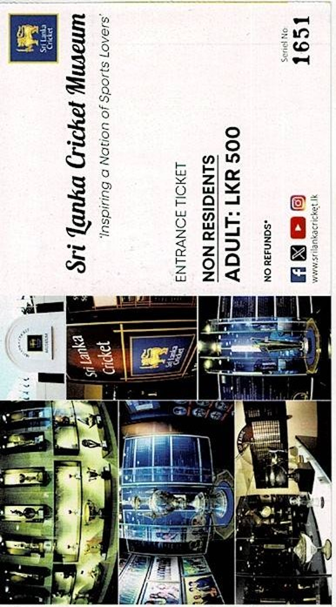
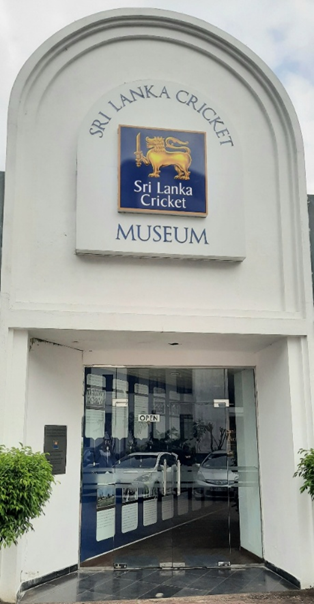
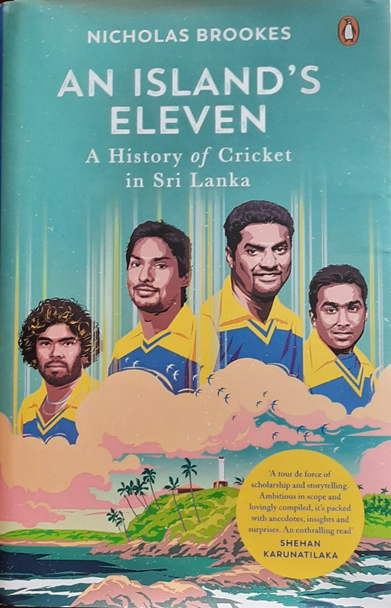
As per its website, the museum covers the history of cricket in the country. It claims to document the country’s journey towards becoming a Test nation and its achievements made during the pre and post Test cricket era. It includes a ‘Hall of Fame’, as well as significant cricketing ‘moments’ and ‘turning points’ in Sri Lanka’s cricketing history. However, being one who had already gone through Nicholas Brookes’ excellent book “An Island’s Eleven: A History of Cricket in Sri Lanka,” my expectations were perhaps a bit higher and were somewhat belied when I visited the place in person. Was it the MCC Museum at Lord’s that had set some sort of a ‘benchmark’ in my mind – perhaps …!
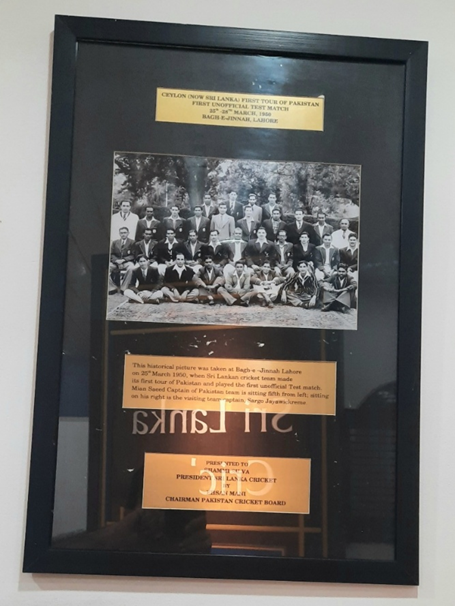
This relatively small-sized museum is quite well-organized although it in no way reflects the rich history of Lankan cricket prior to mid-1990s. The nation’s international cricket journey actually completed half a decade in Jun-2025, yet there is very little mention of stalwarts from the 1970s and 1980s like Anura Tennekoon, Duleep Mendis, Tony Opatha, Roy Dias, Ashantha de Mel, Rumesh Ratnayeke, et al.
Neither are there any photographs of their first-ever World Cup participation (in England in Jun-1975) or first-ever World Cup match win (against India in Jun-1979), nor any memorabilia about their first-ever Test match (against England in Feb-1982) or first-ever Test match-cum-series win (against India in Sep-1985). Many Indian cricket-lovers from those days still remember the pain caused by those two losses of the Indian sides, led by Venkat and Kapil, respectively.
It seemed to me that focus has so far been given to the country’s journey in limited overs cricket, and that too since its pathbreaking victory in Wills World Cup aka CWC-1996. Of course that has indeed been a watershed event for the entire cricketing world. However, that tough journey in international cricket began with the Prudential World Cup aka CWC-1975, where the mighty Aussie pace bowling attack was put to sword by Ranjith Fernando, Sunil Wettimuny, Duleep Mendis, Anura Tennekoon and Michael Tissera.
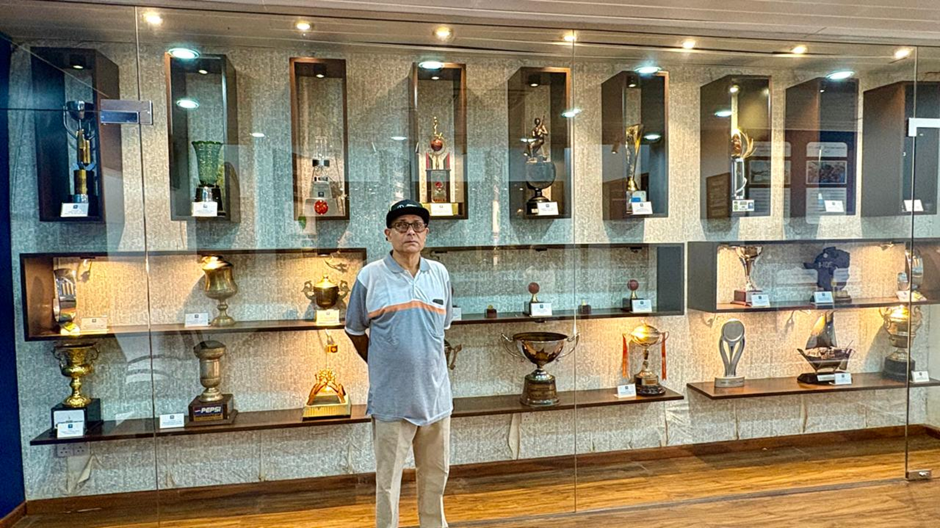
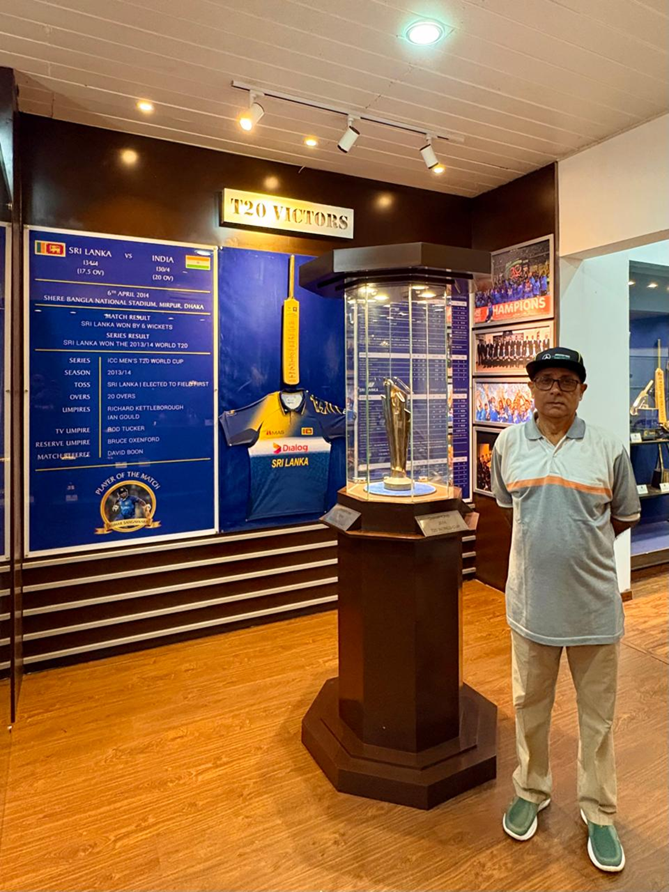
The trophy cabinets are well-decorated, as one can see, with the major attractions being the 1996 World Cup trophy and the 2014 T20 World Cup trophy.
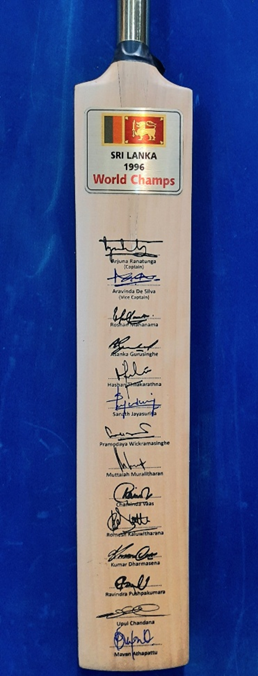
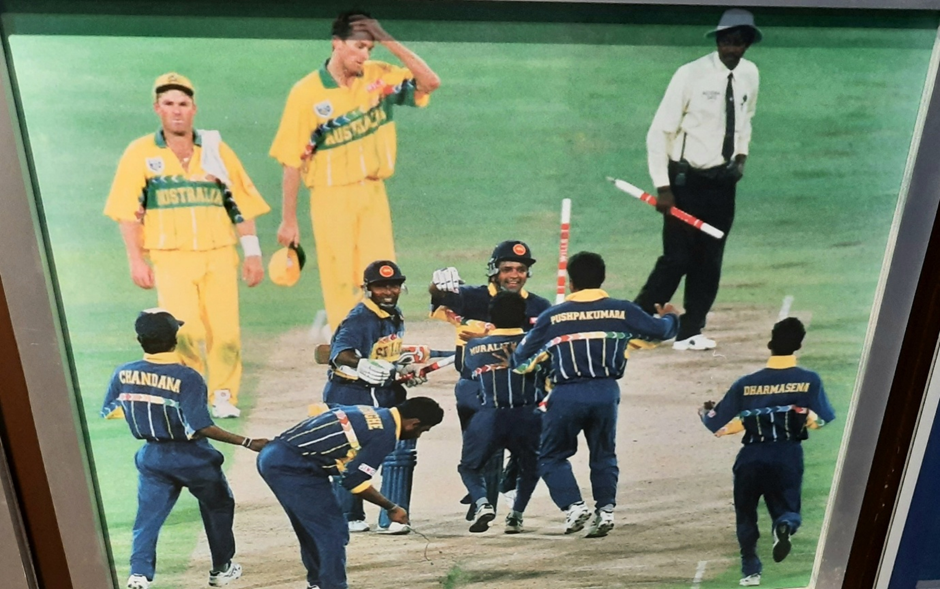
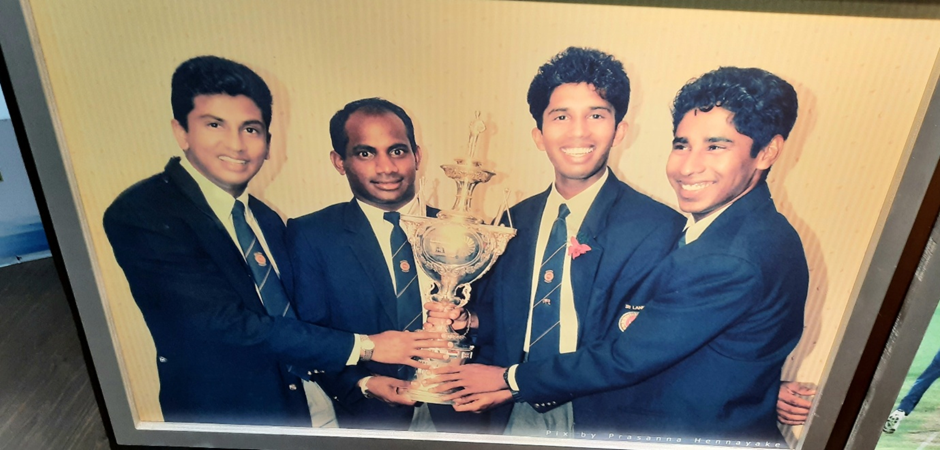
Many Indian cricket-lovers, aged 35-or-more, still are unable to get over their CWC-1996 semi-final loss at the Eden Gardens, but it undoubtedly was a worthy win for that excellent Lankan side, brilliantly led by Arjuna Ranatunga, and their signatures on the bat surely remind us of them.
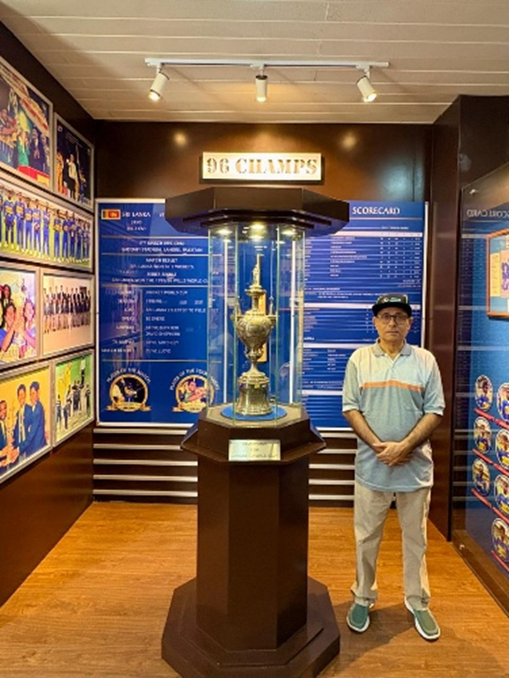
The gallery also shows some photos of those triumphant moments at Lahore. The smiling faces of the winning cricketers depict the enormous joy and pride that was brought to Lankan cricket on that occasion.
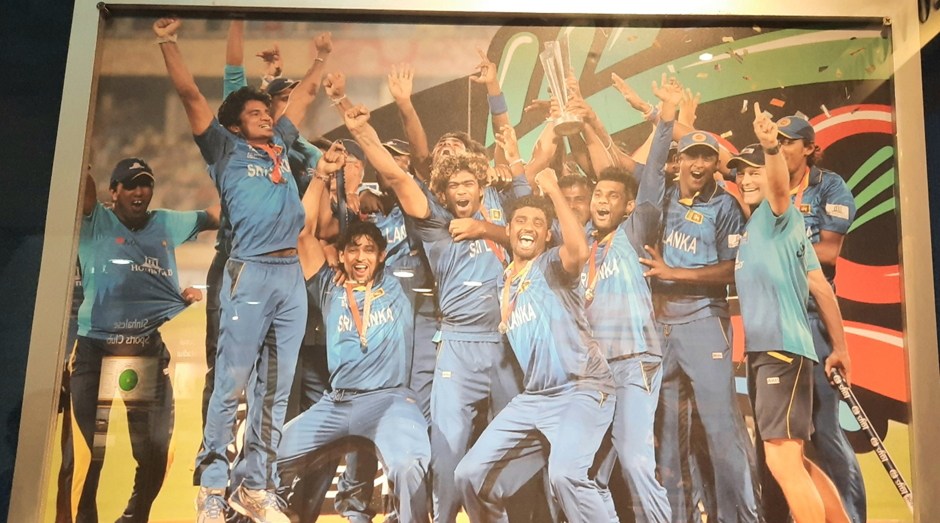
Another very big moment in international cricket came for Sri Lanka when they won the final of T20I World Cup tournament in 2014 at Mirpur, Dhaka, beating India by six wickets. That victorious side was led by Lasith Malinga, and contained stars like Kumar Sangakkara, Mahela Jayawardene, Tillakaratne Dilshan, Angelo Mathews, and Rangana Herath. It was the last T20I match that Sangakkara and Jayawardene played for their country, the former being declared as the Player of the Match for his innings of 52 not out (in 35 balls). The photo of the victory podium occupied by the winning cricketers reflects the elation the entire nation felt that day. That was the last time Sri Lanka won any major ICC cricket tournament for men.
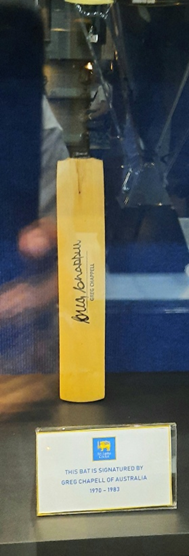
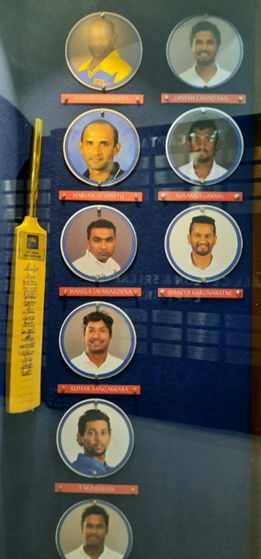
It was exciting to have a look at a bat signed by quite a few of the well-known Lankan cricketers who captained their Test teams, next to another bat signed by the Aussie great Greg Chappell.
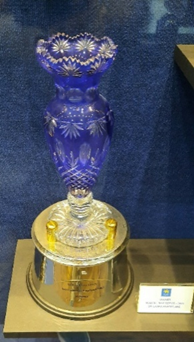
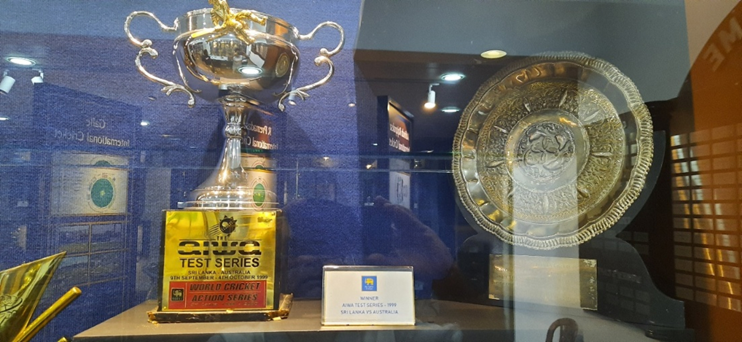
Some trophies related to Test cricket arena were also on display, of which a couple drew my special attention – against Australia at home in 1999 and against England at home in 2003-04.
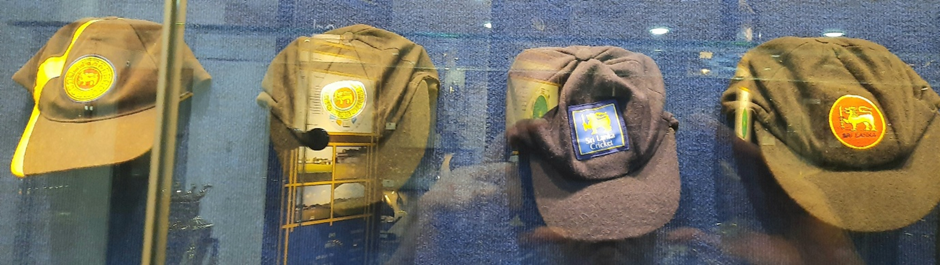
And to cap it all, some cricket caps with team emblems are bound to remind one of the honour of playing for a national side.
Sinhalese Sports Club (SSC) Cricket Ground, Colombo
Barely hundred metres from the Cricket Museum lies the SSC premises. The club was founded in 1899 by a group of distinguished Ceylonese consisting of lawyers, legislators, businessmen, proprietary planters and civil society leaders of that time, and was established as a cricket club. Even after 125-plus years, cricket is its core activity. The cricket academy here, known as the SSC School of Cricket, has been in operation for over two decades for boys of ages from six to 24.
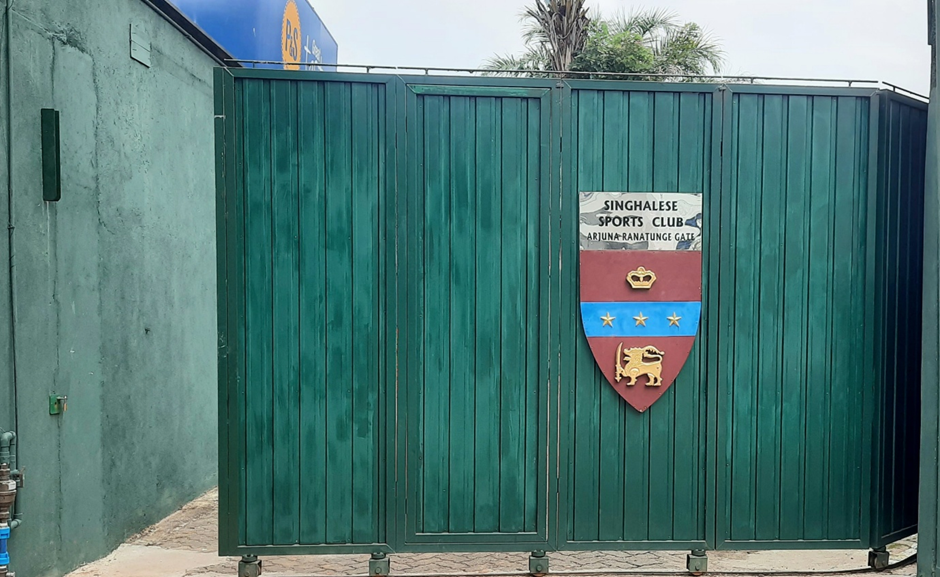
Two world records are attributed to this cricket venue: [a] highest-ever partnership in Test (and First-Class) cricket for any wicket – 624 runs between Jayawardane (374) and Sangakkara (287) for the 3rd wicket against South Africa in Jul-2006; [b] highest number of Test wickets captured by any bowler at any one single venue – Muralidaran’s 166 wickets from 24 matches. As one can see, one of its gates is named after Ranatunga, perhaps somewhat akin to the Grace Gate at the Lord’s. No wonder many Lankan cricketers and cricket-lovers wax eloquent about this place, and the ground is sometimes described as “the Lord’s of Sri Lanka”!
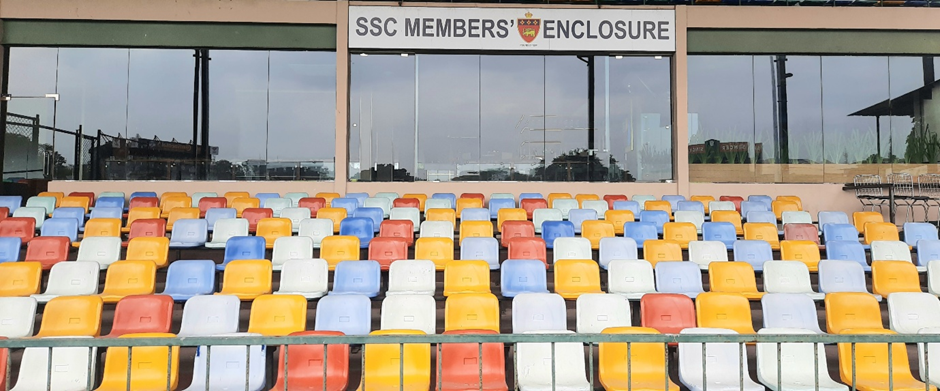
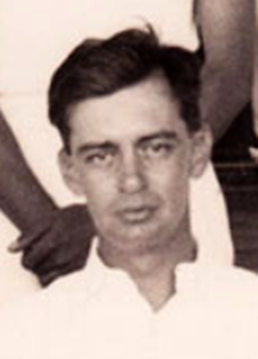
It was nice to see the pavilion being named in memory of Frederick Cecil De Saram, a right-handed batsman, who played 40 first-class matches for Ceylon and for Oxford University, for whom he scored 128 runs against the touring Aussie side that included Clarrie Grimmett, Stan McCabe, Chuck Fleetwood-Smith in 1934. He captained the Ceylon cricket team from 1949 to 1954 and is considered to be one of the greatest Sri Lankan cricketers of the pre-Test era.
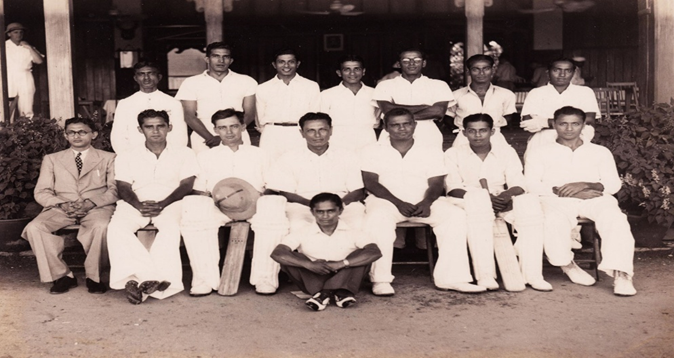
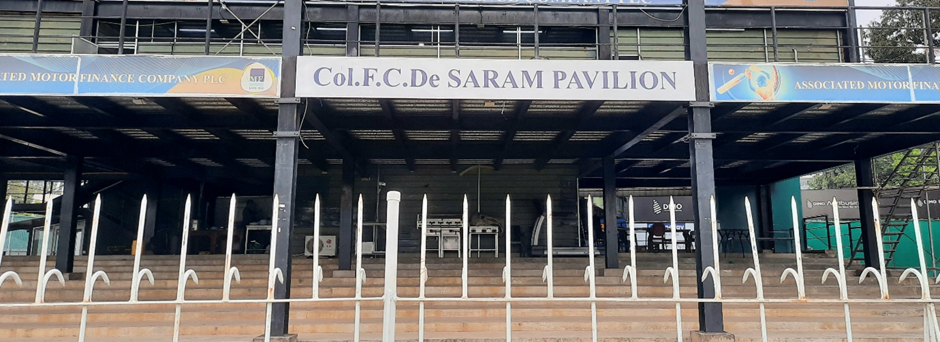
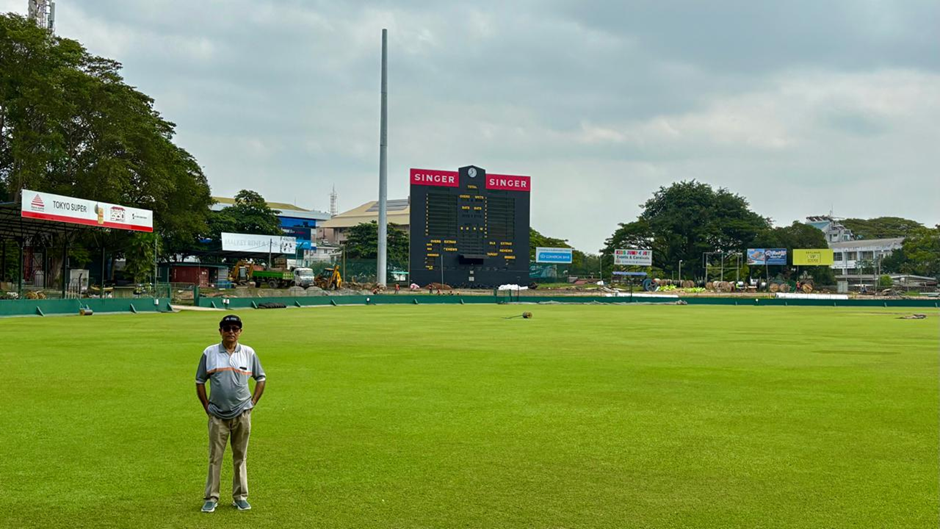
Galle Cricket Stadium, Galle
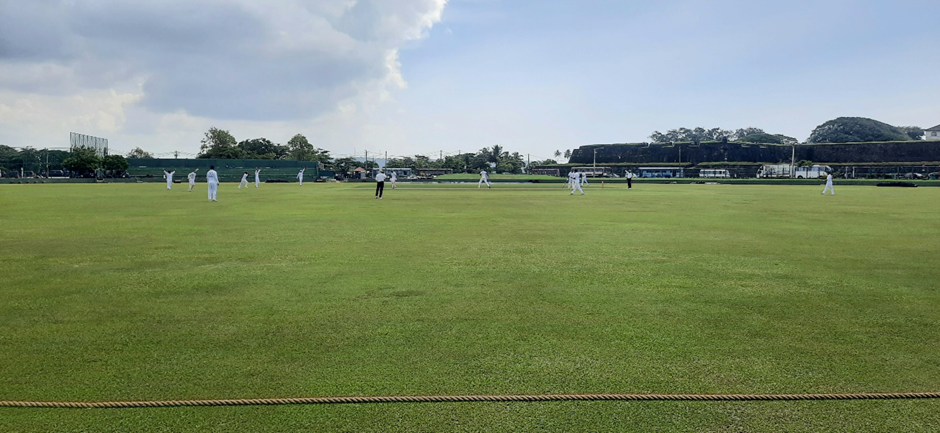
With the Indian Ocean visible on two sides of the ground and the famous clock-tower of the 16th-century Dutch fort towering above, Galle’s international cricket stadium, aka the ‘Esplanade’, was one of the most scenic cricket venues in the world, until it was devastated by the terrible tsunami that struck on December 26, 2004. Thanks to international support from many luminaries, including Ian Botham and Shane Warne, a pledge was made to rebuild the ground from scratch, and the re-constructed stadium was opened by the then President of Sri Lanka on December 17, 2007, a day before Test cricket resumed there with the home side playing against the touring English side. Since then the venue has been glowing again with its beauty, as one can see in the photo below that was taken from the grass-covered wide rampart of the fort.
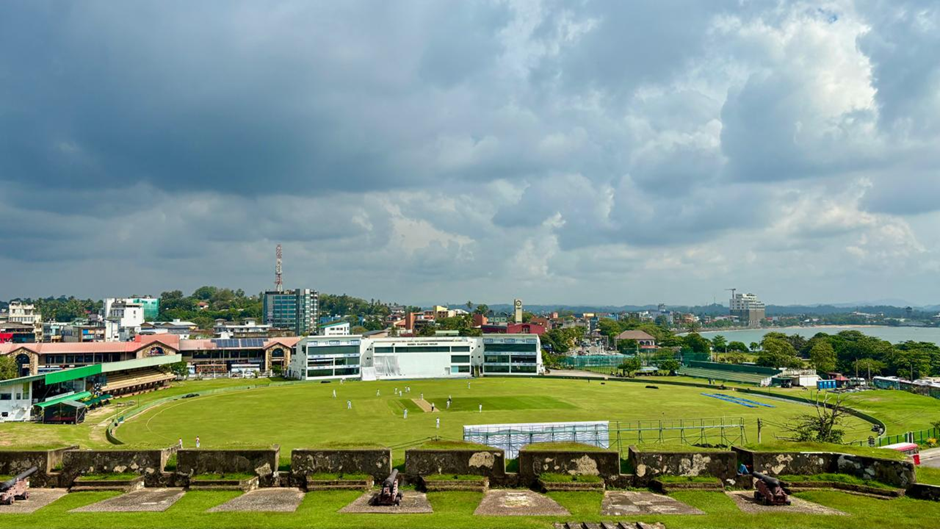
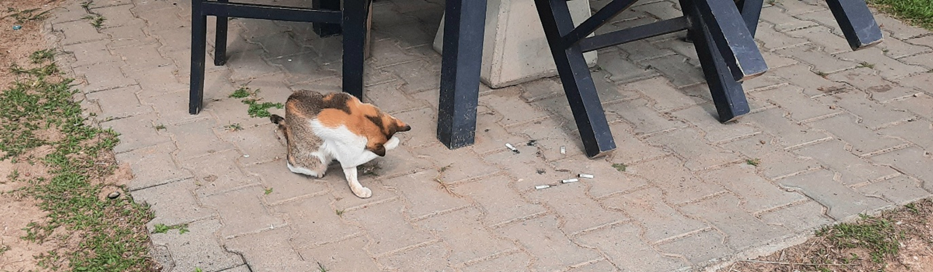
This venue subsequently became witness to two phenomenal bowling records: [a] Muralidaran became the highest Test wicket taker (800 wickets from 133 matches) on July 22, 2010 when he played his last Test against India; [b] Herath became the most successful left-arm spinner in Test cricket history by capturing his 363rd wicket (in his 79th match) on March 11, 2017 when he played against Bangladesh. No wonder the Lankan spinners would continue to have a fascination with this ground, and I am quite sure that its resident feline creature, although not as famous as ‘Peter the Cat’ of Lord’s, loves this place as much!
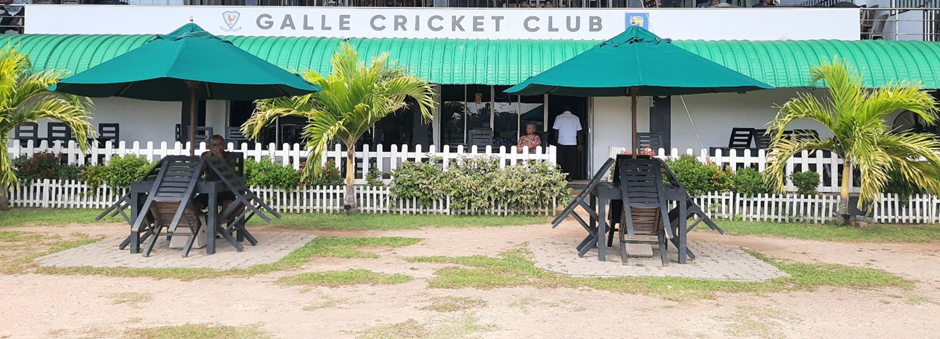
The Galle Cricket Club, which has produced well-known international cricketers like Romesh Kaluwitharana, Nuwan Kulasekara and Lasith Malinga, uses this venue as its home ground, and regular cricket matches are played here. We were witness to one such match during our visit.
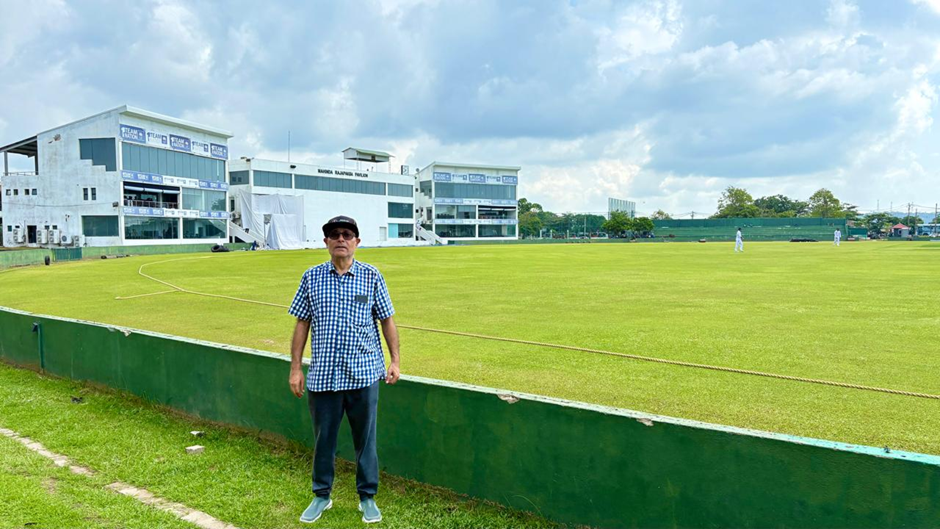
I wish we could as well visit the Pallekele International Cricket Stadium near the beautiful city of Kandy but our pre-planned visits to the Dumbulla Cave Rock Temple and the Temple of the Sacred Tooth Relic left us no time for that. Sometimes it indeed makes sense for Lord Buddha’s spiritual legacy getting priority over cricketing legends like Doctor WG, Sir Don and Sir Len!
Kalarab Ray, Jan-2026
References:
- “An Island’s Eleven: A History of Cricket in Sri Lanka” by Nicholas Brookes, Penguin Random House India, 2022
- https://www.ceyloncricketmuseum.com/
- https://en.wikipedia.org/wiki/Sri_Lanka_Cricket_Museum
- https://www.ssc.lk/
- https://en.wikipedia.org/wiki/Sinhalese_Sports_Club_Cricket_Ground
- https://en.wikipedia.org/wiki/Fredrick_de_Saram#Cricket_career
- https://www.thecricketmonthly.com/story/1181100/the-cricket-monthly-the-story-of-de-saram-and-satha-batting-geniuses-who-went-to-jail
- https://www.espncricinfo.com/cricket-grounds/galle-international-stadium-59325
- https://en.wikipedia.org/wiki/Galle_International_Stadium
Photographs: from author’s personal collection, except De Saram’s photos that are taken from Internet